Military-Grade Unmanned Aerial Vehicles in Ukraine
Bayraktar TB2 Drone Capabilities and Operations
Few images defined Ukraine’s early resistance like the Bayraktar TB2 hovering over a stalled convoy, then releasing a MAM-L munition into a fuel truck. That Turkish-built drone became the first answer to a common question: what drones are Ukraine using?
The TB2 is a medium-altitude, long-endurance aircraft. It cruises above small arms fire, stays aloft for over 24 hours, and carries laser-guided munitions that let operators identify a target and strike with precision. Its optical and targeting systems were central to early Ukrainian operations against Russian logistics and air defense.
Ukrainian crews used TB2s to:
- Disrupt armor columns advancing on Kyiv
- Destroy radar and anti-aircraft systems
- Target fuel and ammunition resupply convoys
That early success forced Russian forces to adapt. They dispersed supply lines and deployed heavy electronic warfare, which gradually degraded many TB2 operations. The aircraft now flies in more limited roles, but its impact on the early course of the war was significant. For those tracking what drones are Ukraine using today, the TB2 shows how a single platform can shape a battle, then shift as the battlefield evolves.
Switchblade Loitering Munition Models in Service
American made and backpack portable, the Switchblade answers a different question entirely. It is a loitering munition, which means the warhead is the aircraft. Operators launch it from a tube, fly it to a target area, and wait for the right moment to strike.
Ukraine operates two versions. The Switchblade 300 is built for personnel and light trucks. The Switchblade 600 carries a Javelin class warhead for armored vehicles. Both are quiet, small, and difficult to track.
- Switchblade 300: roughly 40 minutes of loiter time
- Switchblade 600: longer range, heavier payload
For those asking what drones are ukraine using, this system matters because it converts a drone into a precision munition. It does not return. It does not need to. It simply waits, then dives.
Phoenix Ghost Kamikaze Drone Specifications
Ask an American officer for Phoenix Ghost specifications and you will get a smile, a shrug, and a classified stamp. That secrecy is the most honest spec sheet around. This tube launched munition is a quiet answer to what drones are ukraine using, because the details are still locked away.
Reports suggest six hours of loiter time, a serious warhead, and software that lets it hover above a target while operators reconsider. It needs no runway. It climbs, waits, and dives.
- Tube launched and easy to hide in a pickup truck.
- Built for armor and command posts, not crowds.
- Operators train in days, which is rare for military kit!
I value that. The Phoenix Ghost is an expendable airframe with a terminal dive and no return ticket. For anyone tracking what drones are ukraine using, that makes it a precise option with a limited supply.
PD-2 Heavy Reconnaissance Drone Variants
The PD-2 heavy reconnaissance drone answers a quieter side of what drones are ukraine using. This machine does not dive onto a target. It lingers at altitude, watching for hours, sending targeting telemetry to soldiers who never see what they are aiming at. That separation between observer and shooter carries an unsettling weight.
Vertical takeoff and landing means a forest clearing is enough for deployment. The variants serve distinct roles:
- an optical reconnaissance model for day and night observation
- an electronic warfare airframe that maps enemy radar
- a signal relay version that extends command links beyond the horizon
Artillery crews wait for its reports. When it identifies a column, the response is swift and impersonal. I find no glory in that, only a cold necessity. Yet I cannot deny the efficiency!
Civilian Drones Repurposed for Front-Line Warfare
DJI Mavic Quadcopters in Combat Roles
When asking what drones are ukraine using, the most common answer is not a sleek military platform but a civilian DJI Mavic. These off the shelf quadcopters, bought for wedding photography and farm surveys, now serve as the eyes of the front line. A single unit can loiter over a trench, relay coordinates, or drop a small explosive charge with surprising accuracy.
Their adaptation follows a simple logic. Military drones require long supply chains. A Mavic fits in a backpack, and its batteries charge from a vehicle outlet. Operators learn the controls in an afternoon, and the footage streams directly to a tablet. This has turned ordinary civilians into battlefield spectators and participants.
Common combat roles for these repurposed drones include:
- Artillery spotting to correct fire within seconds
- Night surveillance using thermal camera attachments
- Single use strikes with improvised munitions
None of this appears in official doctrine, yet it defines the daily reality of this conflict.
Autel Robotics EVO Thermal Drone Usage
While DJI models dominate the visual spectrum, the Autel Robotics EVO series answers a different question about what drones Ukraine is using. Its thermal camera arrives factory calibrated, which means operators can detect body heat through smoke, foliage, and darkness without rigging aftermarket sensors. The EVO’s controller folds into a compact unit, and its transmission resists interference better than many consumer rivals.
Field reports note several advantages:
– Radiometric thermal data for target verification
– Obstacle avoidance that works in low light
– Swappable batteries for extended patrols
These features make the EVO a preferred choice for units that need thermal reconnaissance without the paperwork of military procurement. The drone occupies a practical niche between civilian toys and dedicated military systems, and that space is crowded.
Grenade-Dropping Modifications for Commercial Drones
From that crowded space emerges a utilitarian adaptation. Commercial quadcopters, built for aerial photography, now carry modified release mechanisms that drop munitions on enemy positions. The answer to what drones are Ukraine using extends beyond purpose-built systems. It includes hobbyist frames fitted with improvised rigs. Common modifications include:
- 3D-printed bomb racks attached to standard landing gear
- Reinforced arms to manage heavier payloads
- First-person-view cameras for precise aim
- Servo-driven release triggers wired to spare radio channels
Operators fly these aircraft low and slow. Accuracy depends on altitude and wind. A single drone can loiter above a trench and wait for the right moment. The psychological weight of a hovering drone exceeds its physical payload. For infantry units, these modified aircraft offer immediate fire support without waiting for artillery or air cover. When researchers compile data on what drones are Ukraine using, these repurposed frames appear in vast numbers. The system is cheap, replaceable, and increasingly common.
Commercial Drone Camera and Sensor Upgrades
Ask any signals intercept officer what drones are Ukraine using for reconnaissance, and the answer often involves commercial frames with factory cameras stripped out. The stock sensors that capture wedding footage cannot penetrate dense foliage or detect heat signatures at night. So units install gimbals with thermal modules and laser rangefinders. The footage streams to a ground tablet through encrypted links. It is immediate awareness!
This transforms a fragile aircraft into a surveillance tool. Operators can identify a command post or a mortar position from several hundred meters away. They can mark grid coordinates without exposing infantry. The upgrades are modular. A unit might carry spare sensors in a backpack and swap them in the field. The cost remains a fraction of a military-grade system. And when a drone is lost, they lose only a camera, not a platform worth millions.
3D-Printed Drone Parts and DIY Repairs
Ask what drones are Ukraine using and the list includes civilian quadcopters held together by 3D printed parts. Front line soldiers treat these machines as expendable gear. A cracked arm or broken gimbal mount no longer grounds a drone for weeks. Portable printers and PETG filament produce replacements in the field.
Repairs are pragmatic. Units share open source files for the most fragile components. Common prints include:
- Landing gear skids for rough terrain
- Propeller guards for tight tree line launches
- Battery adapters for mismatched cells
- Antenna mounts for extended range kits
A unit can rebuild a damaged frame overnight. This logistics trail runs on cheap plastic and shared design files. It changes the calculus of drone warfare because the fleet is only as resilient as the repair network behind it.
FPV Drones and Their Tactical Impact
Anatomy of a Modern FPV Drone
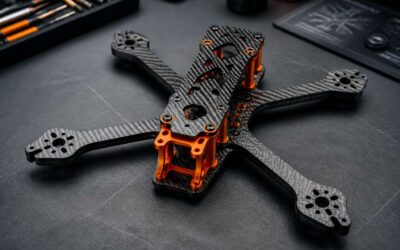
The FPV drone is a study in brutal economy. Its carbon fiber frame, stripped of all comfort, houses a camera, a flight controller, and a warhead. Pilots wear goggles that show a grainy feed, the world reduced to flickering greys. What drones are ukraine using in this endless war? Many are these small, disposable machines, flown directly into armor and infantry positions.
The anatomy tells the story:
– A brushless motor paired with a high-discharge lithium polymer battery, delivering bursts of speed up to 100 km/h
– A digital video transmitter sending a live feed with latency low enough to guide the craft through a window
– An impact fuse that completes its errand on contact
This configuration turns a hobbyist’s toy into a precision instrument of attrition. The operator sits kilometers away, tethered by radio, watching through the drone’s single camera lens until the feed cuts to black.
Ukraine’s Domestic FPV Manufacturing Sector
Ukraine now builds over a million FPV drones a year, a number that has transformed its battlefield strategy. The industry has shifted from improvised garage efforts to a structured manufacturing base. These drones account for a significant share of strikes on Russian armor, giving a persistent reconnaissance-to-attack loop. Tactical impact lies in volume: thousands of sorties each month, each craft carrying a warhead into a target that would otherwise require artillery expenditure.
What makes this sector remarkable is its reliance on consumer supply chains. Standard quadcopter components, 3D-printed frames, and commercial motors are assembled in decentralized workshops across the country. To understand what drones are ukraine using, look at how they are produced:
- Modular airframes designed for rapid field repair
- Low-cost cameras tied to FPV goggles for first-person guidance
- Payload rails adapted for thermite, shaped charges, or fragmentation warheads
This domestic ecosystem enables rapid iteration.
FPV Drone Tactics Against Armored Vehicles
A single FPV drone costs a fraction of a Javelin missile, yet it can disable a tank worth millions. Ukrainian operators fly the craft straight into weak points. Top armor, the engine deck, and the turret ring are the preferred impact zones. A hit there can breach the hull or ignite the ammunition.
The approach is low and fast. The pilot watches through FPV goggles and guides the drone on a terminal run that lasts seconds. Tank crews fire machine guns and deploy electronic jamming, but the small, agile drones are hard to hit.
Tactical patterns have emerged across the frontline:
- Striking the rear engine compartment to immobilize the vehicle
- Targeting open hatches to kill the crew
- Using paired drones, one to suppress and one to finish the job
What drones are Ukraine using for these missions? FPV quadcopters loaded with shaped charges or thermite warheads. They fly low, they fly fast, and they change how armored units operate.
Rapid Drone Upgrade Cycles and Front-Line Adaptations
What drones are Ukraine using today often differs from what they flew last month. The FPV sector moves at a pace that traditional military procurement cannot match. Front-line units modify airframes between missions, swapping out motors, antennas, and warhead configurations in field workshops. Software updates arrive through encrypted channels and change flight behavior overnight.
The tactical impact is immediate. A drone that struggled against Russian electronic warfare last week might carry a different video transmitter this week. Operators share frequency-hopping patterns and jamming-resistant receivers across brigade chat groups. Common front-line adaptations include:
- Reinforced frames that survive hard landings
- Custom-shaped warheads for specific armor types
- Extended-range antennas for deeper strikes
This cycle keeps Ukrainian FPV fleets unpredictable. What drones are Ukraine using next month will depend on what breaks, what gets captured, and what local engineers can improvise. That adaptability carries the fight forward.
Electronic Warfare and Drone Jamming Countermeasures
Russia’s electronic warfare units saturate the front line with jamming signals designed to sever the control link between an FPV drone and its operator. A drone that loses that link falls short of its target. Ukrainian countermeasures have grown equally resourceful, and this electronic contest now decides which side’s FPVs complete their strikes.
What drones are Ukraine using today matters less than how those drones resist jamming. Frequency hopping, pre-set waypoints, and hardened video transmitters keep FPVs flying through contested spectrum. Operators also rely on:
- Directional patch antennas that concentrate signal strength
- Autonomous flight modes that complete strikes without live control
- Analog video fallbacks when digital links fail
Each fix forces Russian jammers to recalibrate, a cycle that shows no sign of slowing.
FPV Pilot Training and Specialized Operations
Across the battlefields, the question of what drones are Ukraine using has shifted from platform types to crew skill. FPV pilots train relentlessly, often flying hundreds of sorties before their first confirmed strike. The tactical impact of these small aircraft lies in their precision and speed, a single frame can decide an assault’s outcome.
Specialized operations now pair reconnaissance teams with FPV crews in coordinated runs. Pilots learn to read terrain, wind, and thermal currents instinctively.
– Ranging a target before first payload release
– Timing strikes between enemy reload cycles
– Coordinating multiple drones on one objective
This schooling costs lives to ignore. Skilled operators extend the effective range of every other unit, turning cheap parts into battlefield authority. Ukraine’s adaptation depends on these trained eyes, not just the airframes they fly.
Long-Range Strike and Naval Drone Systems
UJ-22 Long-Range Strike Drone Capabilities
One answer to what drones are Ukraine using for deep strikes is the UJ 22, a fixed wing system from Ukrainian manufacturer UkrJet. It carries a 40 kilogram warhead up to 800 kilometers, putting Russian airbases and supply depots in range. The airframe uses composite materials to reduce radar reflection, and a truck mounted catapult launches it without a runway.
The UJ 22 serves multiple roles. Its nose can swap between a high explosive charge and a sensor package for target assessment. Operators fly pre programmed routes, which limits exposure to jamming, though the system still depends on GPS for terminal accuracy. A typical mission profile includes low altitude terrain following, descent at the target, and a timed detonation.
This endurance and payload provide a cost effective way to pressure rear areas. Naval drones, like the unmanned surface vessels in the Black Sea, follow the same principle: use small, expendable platforms to force an expensive response.
Bober Loitering Munition and Deep Strikes
The Bober loitering munition is another answer to what drones are Ukraine using for deep strikes. It’s a small jet-powered drone with a 20 kilogram warhead and a range around 100 kilometers. The name means “beaver” in Ukrainian. It targets radar installations and command posts.
The drone loiters at altitude until operators identify a target. Then it dives. Unlike the UJ-22, Bober is built for one mission. There is no recovery. The warhead is the payload.
Naval drones add another layer. Ukraine’s unmanned surface vessels have struck Russian warships in the Black Sea. They carry smaller warheads but rely on speed and a low profile. These vessels are expendable by design.
A typical deep strike package might include:
- Bober loitering munitions for fixed targets
- Naval drones for maritime assets
- Decoy drones to saturate air defences
This combination forces Russia to spend expensive missiles on cheap targets.
MAGURA V5 Naval Drone Specifications
If you want to know what drones are ukraine using to push back against naval threats, look at the MAGURA V5. This unmanned surface vessel measures 5.5 meters and hits 42 knots. It carries a 200 kilogram warhead across 800 kilometers. I must say, the numbers are impressive!
The key specifications include:
- Length: 5.5 meters
- Top speed: 42 knots
- Operational range: 800 kilometers
- Warhead: 200 kilograms
The MAGURA V5 loiters near the coast, waits for a target, and then accelerates. Operators guide it from a secure location. This system expands Ukraine’s strike options from the air into the maritime domain. Russian ships now need to account for a threat that skims the water at high speed. The result is a naval drone that combines endurance with striking power.
Sea Baby Unmanned Vessel Black Sea Operations
Sea Baby is a naval drone that has already struck the Kerch Bridge and Russian warships. It carries an explosive payload across long distances, forcing commanders to keep their ships out of reach.
When assessing what drones are ukraine using for long-range naval operations, Sea Baby matters. Its operational profile includes:
- Extended loitering to wait for high-value targets
- Remote guidance from secure land stations
- Surge speed for final attack runs
These capabilities allow Ukraine to project power without risking pilots or sailors. The drone operates at the waterline, difficult to detect on radar. Russian commanders face a choice: defend against a swarm of these vessels or expose their most valuable ships. The uncertainty alone has psychological effects that extend beyond the physical damage.
Coordinated Air and Sea Drone Strike Tactics
Coordinated strikes now pair aerial loitering munitions with naval drones in a single wave. Airborne assets search for radar emissions while sea drones approach from the coastline. This convergence forces Russian air defense to split its attention between low-flying drones and surface contacts.
When planners ask what drones are Ukraine using for these missions, they consider timing and frequency. Aerial drones can suppress air defenses while sea drones target the same command node. One operator may launch a decoy drone to trigger enemy radar, then send a naval drone along the same bearing.
- Synchronize loiter times to create overlapping windows
- Use aerial reconnaissance to confirm naval target coordinates
- Sequence strikes so air defense reloads become predictable
Reconnaissance, Surveillance, and Electronic Warfare Drones
Shark UAV and Real-Time Intelligence Gathering
Among the systems answering what drones are Ukraine using for persistent surveillance is the Shark UAV, a fixed-wing platform built for quiet endurance. The Shark carries electro-optical and infrared sensors that stream high-resolution video to ground stations in real time. Its electronic warfare suite detects radio emissions, locates command posts, artillery positions, and air defense radars.
The drone loiters for hours, mapping electronic signatures across the front line. This intelligence shapes strike decisions, often within minutes of detection. The Shark operates beyond visual range, using onboard processors to filter noiseand deliver only actionable data. Its modular design allows rapid sensor swaps, adapting to evolving threats. Ukrainian operators track its feed from hardened shelters, using that observation to direct strikes.
Drone-Based Artillery Fire Adjustment and Targeting
The most critical drone mission in Ukraine is not a single strike, but the endless task of watching and correcting. What drones are Ukraine using for this? They are quiet observers. Reconnaissance drones hover above the battlefield, streaming live coordinates to gun crews below. Each adjustment arrives from a sensor, not a guess.
Electronic warfare platforms expand this reach, locating radio bursts and radar emissions. They pinpoint enemy batteries before a single round falls. This data feeds fire missions directly, shrinking the response time from minutes to seconds.
- Target acquisition through thermal signatures
- Impact assessment after each volley
- Radar location for counter-battery fire
Ukrainian operators use these findings to reset trajectories, accounting for wind and terrain. The drones loiter overhead, watching shells land, then nudge fire closer. This loop, repeated daily, has turned artillery into a precision weapon. For South African readers following the conflict, this is how technology reshapes warfare.
Satellite-Connected Long-Endurance Drones
Reconnaissance, surveillance, and electronic warfare drones constitute Ukraine’s aerial intelligence. The question of what drones are Ukraine using for sustained surveillance highlights how these platforms operate beyond tactical quadcopters. Satellite-connected long-endurance drones circle for over a day, streaming secure data to command networks without interference from frontline jamming.
Electronic warfare drones fly below radar coverage, detecting radio emissions and radar activity. By triangulating sources, they build a picture of enemy command posts and artillery batteries. This information drives counter-battery fire and ambush planning!
- Signal mapping to identify unit boundaries
- Radio intercept for early warning
- Relay nodes for rear communication
Satellite links extend range further, letting drones operate hundreds of kilometers beyond visual line of sight. Their endurance allows continuous monitoring of supply routes and reserve formations. For South African readers, the answer to what drones are Ukraine using lies in this persistent, networked surveillance!


0 Comments